
A restaurant owner in Khalifa City once told us he lost an entire week’s worth of frozen seafood stock in a single afternoon. Not because the truck broke down. Not because the driver took a wrong turn. Because the chiller truck he hired looked fine from the outside, the paperwork was in order, and the price was good — and nobody told him the compressor was running six degrees warmer than the display showed. By the time the delivery reached his kitchen, the problem was visible. By the time he realised how long it had been going on, the bill was considerably larger than whatever he had saved renting the cheaper option.
Stories like this are more common in Abu Dhabi than they should be, and they share the same root cause: businesses choosing a chiller truck based on price and availability without knowing what questions to actually ask.
This guide changes that. Whether you run a supermarket, a catering company, a pharmaceutical distributor, a hotel, or a food production facility in Abu Dhabi, here is everything you need to know about chiller truck rental — sizes, temperatures, compliance, pricing, seasonal considerations, and the specific questions that separate a reliable provider from an expensive mistake.
Why Chiller Truck Rental Matters More in Abu Dhabi Than Almost Anywhere Else
Abu Dhabi is one of the hottest urban environments on the planet for more than five months of the year. Between May and September, ambient temperatures regularly exceed 45°C, and road surface temperatures can climb past 60°C during peak afternoon hours. A standard delivery truck left in direct sun during a 30-minute loading stop will reach internal temperatures that begin destroying perishable goods within minutes.
This is why cold chain transport in Abu Dhabi isn’t optional for businesses handling perishable goods — it’s a basic operational requirement. But it’s also why the quality of your chiller truck rental matters so much more here than it would in a cooler climate. A refrigeration unit that operates comfortably in a European summer may struggle to maintain temperature in Abu Dhabi’s July heat, particularly on longer routes or with frequent door openings at multi-stop deliveries.
The businesses that get this right — supermarkets, hotel groups, pharmaceutical distributors, catering companies, food manufacturers — treat their cold transport partner as a critical supplier, not a commodity booking. The businesses that get it wrong find out what “cold chain failure” means in practice when their produce arrives outside its safe temperature window.
Chiller Truck Sizes in Abu Dhabi: Matching the Right Vehicle to Your Load
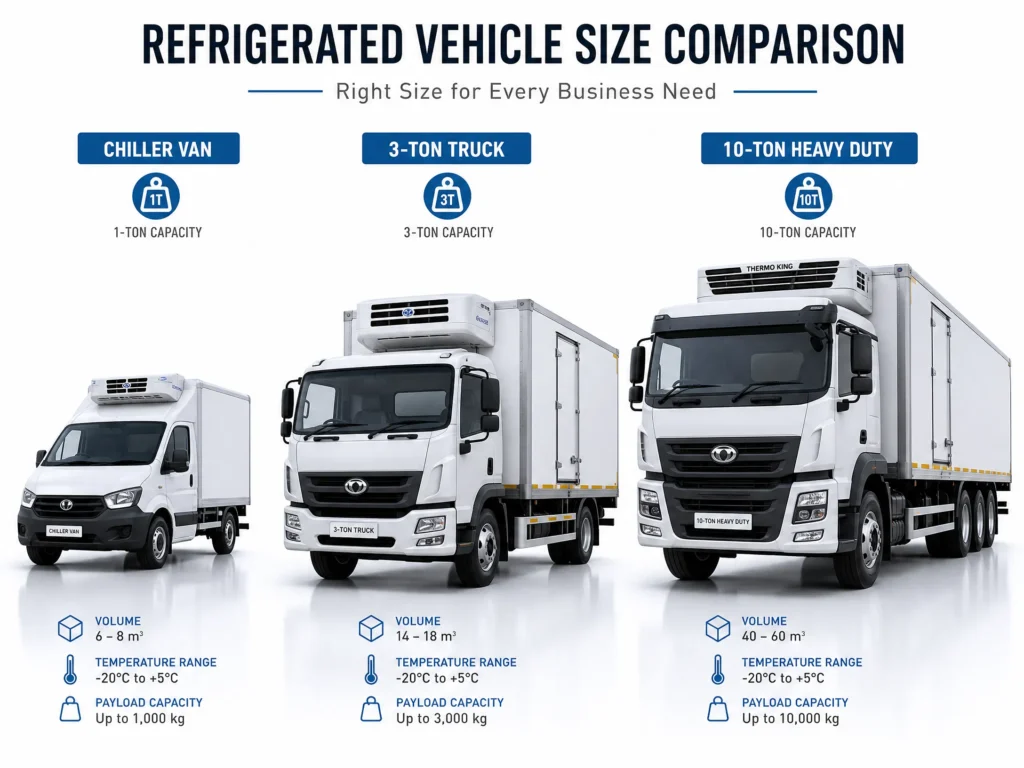
The single most common booking mistake is sizing. Businesses that undersize end up making two trips where one was enough. Businesses that oversize pay for capacity they never use. Here is a straightforward breakdown.
3-Ton Chiller Truck
The most commonly rented size for Abu Dhabi mid-market operations. A 3-ton chiller truck suits supermarket top-up deliveries, restaurant group supply runs across multiple branches, catering deliveries to events, dairy distribution within Abu Dhabi city, and pharmaceutical bulk runs to clinics and hospitals.
In practical terms, a 3-ton truck navigates Mussafah Industrial Area, ICAD, Khalifa City, and Abu Dhabi city centre routes without the access or turning-radius constraints that larger vehicles face. It handles most standard UAE pallet configurations and is the right choice for businesses whose largest single delivery stays within this payload range.
5-Ton Chiller Truck
The step up for businesses with higher volume or longer inter-emirate routes. A 5-ton chiller truck suits food manufacturers in Mussafah distributing to multiple retail points across Abu Dhabi and Dubai, hotel groups managing weekly produce supply to multiple properties, and larger supermarket chains restocking full category loads rather than top-ups.
This size is particularly practical for Abu Dhabi to Al Ain routes, where the longer journey time rewards a larger payload per trip.
7-Ton to 10-Ton Chiller Truck
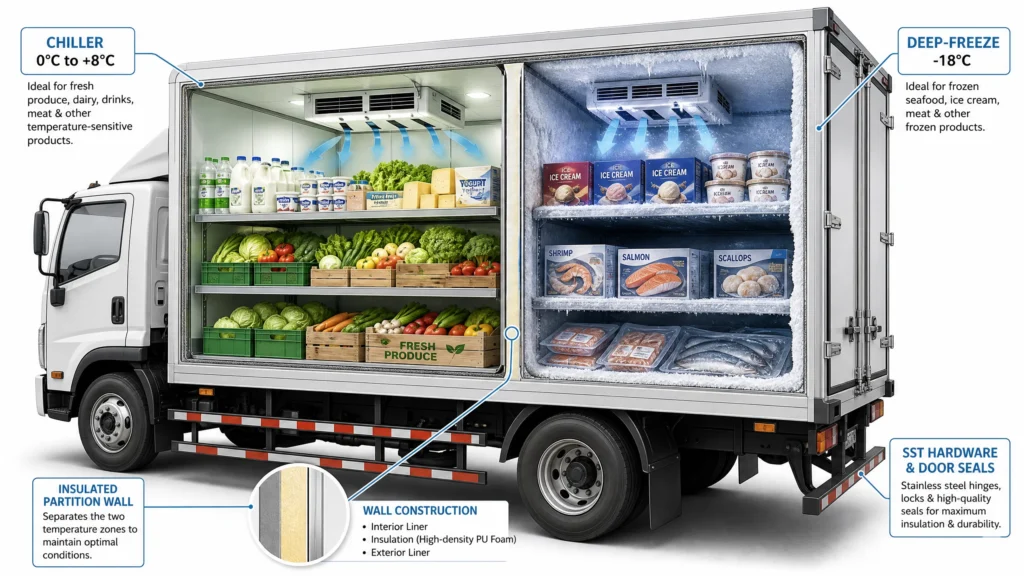
Built for high-volume cold chain operations. This is the vehicle for bulk food distribution, large-scale pharmaceutical supply, wholesale meat and seafood distribution, and primary restocking of major hypermarkets. At this size, multi-temperature compartments become relevant — internal partitions that allow one zone to run at chiller temperatures for fresh produce while a second maintains deep-freeze for frozen goods on the same vehicle.
Which Size Should You Book?
The honest answer depends on one calculation: your heaviest delivery day, not your average day. If your typical Monday run is 2.5 tons but your Thursday restock runs to 4 tons, book a 5-ton truck for the contract. The cost of a second trip during your peak run will always exceed the small daily saving from booking the smaller vehicle.
Understanding Temperature Ranges: Chiller, Freezer, and Multi-Temperature
The term “chiller truck” covers a range of vehicles with meaningfully different temperature capabilities. Knowing which you need before you book protects your cargo from the start.
Chiller range (0°C to +8°C): Used for fresh dairy, cut flowers, fresh meat and fish, ready-to-eat food, fresh produce, beverages, and standard cold-chain pharmaceuticals. The goal is keeping products cool without freezing them — dairy held below 0°C, for example, suffers texture damage that makes it unsaleable.
Deep-freeze range (-18°C to -22°C): Required for frozen meat, frozen seafood, ice cream, frozen ready meals, and bulk frozen vegetables. These products need to stay fully frozen throughout transit — partial thawing and refreezing damages quality and, for meat and seafood, creates serious food safety risks.
Pharmaceutical range (2°C to 8°C): A narrower subset of the chiller range. Many vaccines, biologics, and temperature-sensitive medicines require that temperature never drifts outside this 6-degree window, even briefly. Standard chiller trucks used for food may not provide the monitoring precision pharmaceutical cargo requires — more on this below.
Multi-temperature configuration: Vehicles with internal partition walls that maintain two separate temperature zones simultaneously. Useful when your delivery includes both fresh and frozen goods to the same customer, eliminating the need for two separate vehicles on the same route.
A practical tip: always ask your provider what temperature the vehicle actually maintains during a full load on an Abu Dhabi summer afternoon, not what the specification sheet says. These are sometimes different numbers.
ADAFSA, HACCP, GCCA, and MOCCAE: Compliance in Abu Dhabi Explained Plainly
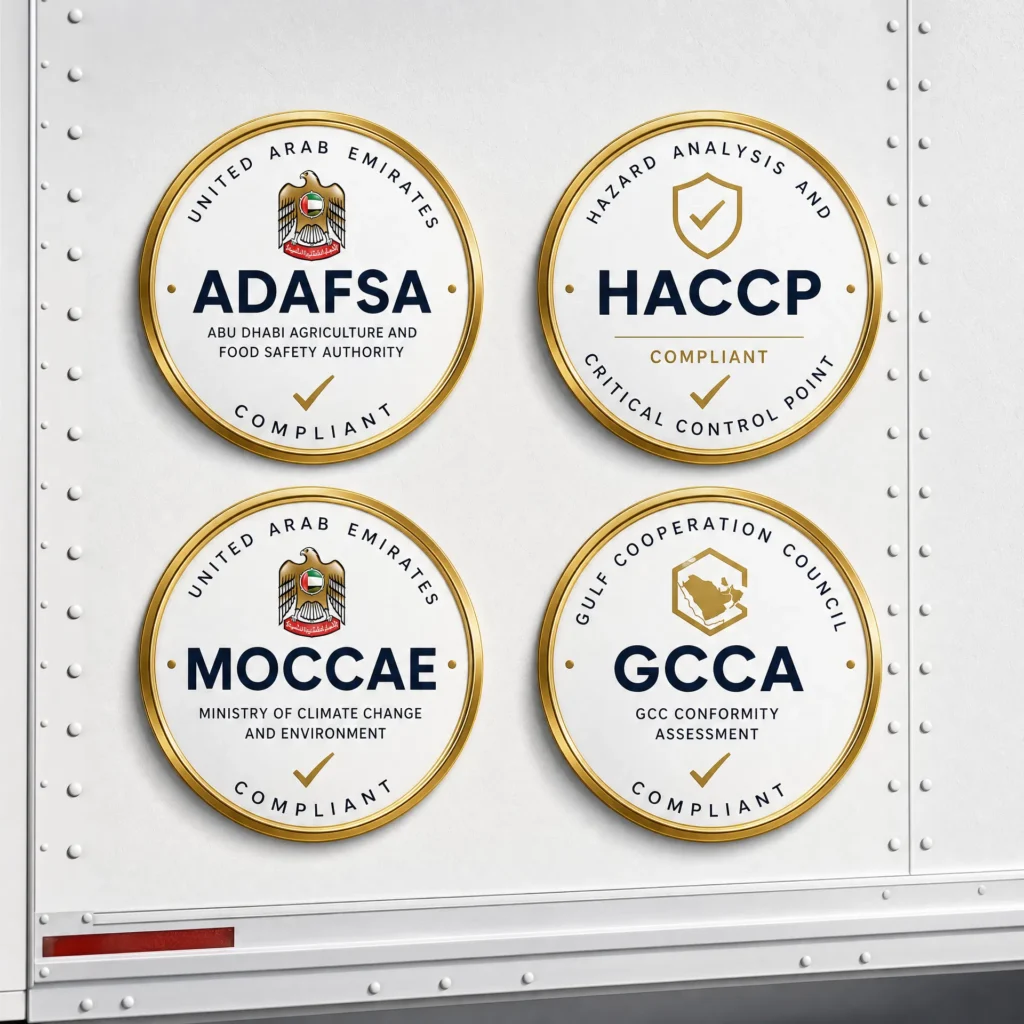
Compliance in Abu Dhabi cold chain transport is not one standard. It is several overlapping frameworks, and which ones apply to your business depends on what you are carrying, where you are delivering, and who you are delivering to.
ADAFSA
The Abu Dhabi Agriculture and Food Safety Authority governs food safety standards specifically within Abu Dhabi emirate, including all aspects of food transport — vehicle hygiene, temperature maintenance, driver food handling awareness, and documentation. If you are transporting food cargo anywhere within Abu Dhabi, your transport provider should be ADAFSA compliant. Hotels, hospitals, government institutions, and major supermarket chains routinely check ADAFSA compliance during supplier audits. Discovering your transport provider was not compliant during one of these audits is significantly more disruptive than verifying compliance before you sign the contract.
HACCP
Hazard Analysis and Critical Control Points is the internationally recognised food safety methodology that systematically identifies where contamination or temperature failure can occur in a supply chain and puts documented controls at each critical point. A genuinely HACCP-certified transport provider has written procedures for pre-cooling vehicles, loading protocols, transit temperature monitoring, driver behaviour during delivery stops, and unloading. They can show you these procedures. A provider with a HACCP logo on their website but no documentable processes behind it is carrying the badge without the substance.
MOCCAE
The Ministry of Climate Change and Environment sets federal-level food safety and animal product handling standards that apply across all seven emirates. Cross-emirate shipments — particularly those involving imported meat, dairy, or seafood — typically need to satisfy both MOCCAE federal requirements and the relevant emirate-level standards simultaneously. If your business moves cold cargo between Abu Dhabi and other emirates regularly, federal MOCCAE compliance is relevant to you.
GCCA
The Global Cold Chain Alliance is an international industry body whose best-practice standards go beyond minimum UAE regulatory requirements in areas like temperature management, vehicle maintenance, and staff training. UAE cold chain operators that voluntarily align to GCCA standards are generally operating at a higher level than those that only meet local legal minimums.
Working with a provider authorised under all four frameworks — HACCP, ADAFSA, GCCA, and MOCCAE — means your cold chain is covered regardless of which regulatory body, hotel procurement team, hospital supplier audit, or government inspection asks for documentation. This matters more than it sounds, because the question of which specific certification applies to any given shipment is rarely one you want to be answering at the point of an audit.

Key Delivery Areas in Abu Dhabi and What Each One Requires
Abu Dhabi’s logistics landscape is genuinely varied, and a provider that knows the emirate’s industrial zones, island developments, and inland routes delivers a meaningfully different service from one that doesn’t.
Mussafah Industrial Area and ICAD
Mussafah and the Industrial City of Abu Dhabi (ICAD I, ICAD II, and ICAD III) are the primary hubs for food distribution, pharmaceutical warehousing, and FMCG storage across the emirate. Most cold chain operations in Abu Dhabi either originate from or pass through this corridor. A provider based here — rather than one dispatching from Dubai or another emirate — offers a meaningful practical advantage: shorter dispatch times, drivers familiar with Mussafah’s internal roads and loading bay protocols, and faster response if a breakdown occurs mid-route.
KIZAD (Khalifa Industrial Zone Abu Dhabi)
KIZAD has specific access requirements for commercial vehicles, including fleet tracking compliance. Providers with vehicles registered on Abu Dhabi’s ASATEEL fleet management system — the mandatory GPS tracking requirement for commercial vehicles accessing Abu Dhabi industrial and free zones — can enter without delays. Vehicles without proper ASATEEL registration face access issues that affect your delivery timeline.
Abu Dhabi City Centre, Corniche, and Island Developments
Hotels on Saadiyat Island, Yas Island, Al Maryah Island, and Reem Island typically have structured delivery windows, service entrance protocols, and in some cases specific vehicle size limits for certain access routes. Caterers, florists, and food suppliers working with these properties benefit from a transport partner whose drivers are familiar with these protocols and don’t need to resolve access problems at the point of delivery.
Al Ain
The Abu Dhabi to Al Ain route adds approximately two hours each way to a standard delivery cycle. In summer, this extended journey time puts additional demand on refrigeration systems — a unit that maintains temperature comfortably on a 45-minute city route may cycle the product temperature higher than ideal on a three-hour return journey if the compressor is not properly rated for sustained operation in 45°C+ ambient heat. For regular Al Ain deliveries, ask your provider specifically whether their vehicles are rated for extended operation in UAE summer conditions.
Ruwais and Western Region
For businesses supplying industrial facilities, hotels, or food retail in Abu Dhabi’s western region, journey times can reach three hours or more from the city. Temperature monitoring on these routes is particularly important — and continuous logging rather than spot checks is the only way to verify what actually happened to your cargo during transit.
Seasonal Considerations: Ramadan, Summer, and Peak Demand Periods
Three periods in the Abu Dhabi logistics calendar create consistently elevated demand for chiller truck rental and affect pricing, availability, and operational requirements.
UAE Summer (June to September): Peak stress on refrigeration systems and the period when temperature management is most critical. Pre-cooling vehicles before loading is non-negotiable during these months. Businesses that lock in long-term contracts before summer typically secure better rates and priority vehicle access compared to those booking month-to-month during peak demand.
Ramadan: Food distribution volume increases significantly across all categories during Ramadan. Restaurant and catering delivery requirements expand, retail restocking frequency increases, and the pre-Iftar delivery window creates concentrated demand in the late afternoon. Booking chiller trucks for Ramadan well in advance — ideally 4 to 6 weeks before the start of the month — prevents the availability crunch that affects businesses that leave it too late.
UAE National Day and Public Holiday periods: Event catering, hotel group supply, and government venue provisioning create short spikes in chiller truck demand around UAE National Day in December and other major public holidays. One-off and short-term rental rates typically rise during these windows.
What Good Chiller Truck Rental Actually Looks Like: A Practical Checklist
Before signing any chiller truck rental agreement in Abu Dhabi, work through these questions. A provider who hesitates or cannot answer specifically is giving you important information.
Is the vehicle pre-cooled to the required temperature before cargo is loaded? Loading product into a truck that has not yet reached operating temperature means your cargo absorbs heat during the first portion of the journey. Good providers pre-cool as standard. Less careful ones skip it.
What temperature does the vehicle actually maintain under a full load during UAE summer? Not the rated temperature — the maintained temperature. These can differ by several degrees in high-ambient conditions.
Is temperature monitoring continuous throughout the journey, or only checked at pickup and drop-off? Continuous data logging provides an actual audit trail. A single reading at each end of the journey tells you almost nothing about what happened in between.
Are HACCP, ADAFSA, GCCA, and MOCCAE certifications current and documentable? Logos on a website are not the same as current certifications you can inspect. Ask for documentation.
What happens if the vehicle develops a fault during a delivery? Specifically: is a backup vehicle available, where is it based, and how quickly can it reach your route? In Abu Dhabi summer, a failed refrigeration unit is an emergency that needs resolving in minutes.
Are drivers trained in cold chain handling protocols? Driver behaviour during loading stops — door-open time, separation of cargo types, awareness of temperature logs — affects your cold chain as much as the vehicle’s refrigeration system.

How Much Does Chiller Truck Rental Cost in Abu Dhabi?
Current market rates in Abu Dhabi for chiller truck rental vary based on vehicle size, rental duration, route distance, and whether a driver is included. Here is a realistic guide to pricing as of 2026:
- 3-ton chiller truck, daily rental: From AED 350 to AED 500 per day with driver
- 5-ton chiller truck, daily rental: From AED 500 to AED 700 per day with driver
- 7-ton chiller truck, daily rental: From AED 700 to AED 950 per day with driver
- 10-ton chiller truck, daily rental: From AED 850 to AED 1,200 per day with driver
- Weekly contract rates: Typically 15 to 20 percent below the daily equivalent
- Monthly contract rates: Typically 20 to 30 percent below the daily equivalent, with priority dispatch and dedicated vehicle allocation
Long-term contracts — monthly or quarterly arrangements — offer the most significant cost advantages and protect your business from the availability and pricing pressure that affects short-term bookers during Ramadan and summer peak periods.
One note on cost comparison: the price gap between a well-maintained, fully certified provider and a cheaper alternative usually closes quickly when you account for the value of cargo that arrives within its safe temperature window every time, documentation that holds up when a customer or authority asks for it, and a backup plan that actually works when something goes wrong on a 45°C afternoon.
Frequently Asked Questions About Chiller Truck Rental in Abu Dhabi
What is the difference between a chiller truck and a freezer truck? A chiller truck maintains temperatures between 0°C and +8°C, suited for fresh food, dairy, pharmaceuticals, flowers, and beverages. A freezer truck operates at -18°C to -22°C for frozen meat, seafood, ice cream, and deep-frozen goods. Some larger vehicles offer multi-temperature compartments running both zones simultaneously on the same vehicle.
How much does it cost to rent a chiller truck in Abu Dhabi per day? A 3-ton chiller truck with driver typically starts from AED 350 per day. Larger 5-ton trucks range from AED 500 to AED 700, and 10-ton trucks from AED 850 to AED 1,200 per day. Monthly contracts reduce these rates by 20 to 30 percent and include priority vehicle access.
Do chiller trucks in Abu Dhabi need to be ADAFSA certified? ADAFSA compliance is the standard for food cargo transport within Abu Dhabi emirate. Hotels, hospitals, supermarkets, and government institutions routinely require ADAFSA-compliant transport during supplier audits. Working with a provider that is also certified under HACCP, GCCA, and MOCCAE gives full coverage across all cargo types and all seven UAE emirates.
Can I rent a chiller truck in Abu Dhabi for a single day or single delivery? Yes. Daily rentals and single-delivery bookings are available without a long-term contract. Same-day booking is possible with most established providers based in Mussafah. For urgent bookings, calling directly is faster than online booking forms.
Which areas in Abu Dhabi does chiller truck rental cover? A properly operated Abu Dhabi chiller truck service covers the full emirate: Abu Dhabi city centre and islands (Yas, Saadiyat, Reem, Al Maryah), Mussafah, ICAD, KIZAD, Khalifa City, Mohammed Bin Zayed City, Al Ain, Ruwais, and Madinat Zayed. Inter-emirate routes to Dubai, Sharjah, and other emirates are also available at route-based rates.
How far in advance should I book a chiller truck for Ramadan or summer in Abu Dhabi? For Ramadan, book 4 to 6 weeks ahead. For summer operations from June onwards, locking in a monthly contract by April secures your vehicle and rate before seasonal demand peaks. Last-minute bookings during these periods risk both higher rates and reduced vehicle availability.
Working With a Chiller Truck Rental Provider You Can Actually Rely On
Over two decades of operating refrigerated transport across Abu Dhabi and the wider UAE, the pattern in cold chain failures we have seen is consistent: businesses that prioritised price over verifiable compliance and service standards, and found out the cost of that decision when something went wrong mid-summer in the middle of a delivery.
The right chiller truck rental partner in Abu Dhabi answers every question in this guide directly. Their certifications are current and documentable. Their vehicles are maintained and genuinely rated for UAE summer conditions. Their drivers are trained in cold chain protocols, not just licensed to drive. And when something unexpected happens — because in logistics, something eventually does — they have a real plan, not a phone that stops ringing.
UAE7Star Transport has provided HACCP, ADAFSA, GCCA, and MOCCAE-authorised refrigerated transport across Abu Dhabi and all seven UAE emirates for over 20 years. Our chiller truck fleet runs from 3 tons to 10 tons, available on daily, weekly, monthly, and customised long-term contracts, 24 hours a day, seven days a week.
Call or WhatsApp: +971 50 909 2482 Email: uae7startransport@gmail.com Website: www.uae7startransport.com